
The great blue turaco (Corythaeola cristata) is the largest turaco in the world and one of Africa's most spectacular birds. With its vivid turquoise-blue and yellow plumage, prominent crest and large size — up to 75cm long — it is instantly recognisable and never fails to impress even experienced birders visiting Uganda for the first time.
Where to See the Great Blue Turaco in Uganda
Great blue turacos are common and conspicuous in Uganda's forest and forest-edge habitats. The best sites include Entebbe Botanical Gardens (where birds sit openly in the canopy of mature trees — outstanding for photography), Kibale Forest, Bwindi Impenetrable Forest, Semuliki National Park, Maramagambo Forest and the forest patches around Queen Elizabeth National Park. They are also seen along roadsides and in gardens near forests in western Uganda.
Behaviour and Field Notes
Great blue turacos are noisy and social, often found in groups of 3 to 8 birds feeding in fruiting trees. They are not shy and allow close approach when feeding. The distinctive loud, deep call — a series of resonant croaks — carries far and is one of the most evocative sounds of the African forest. In flight the bright red primary feathers flash conspicuously.
Photography Tips
Entebbe Botanical Gardens is the best site for great blue turaco photography — birds are accessible, the light is good on open perches and backgrounds are often clean green forest. Morning visits (7:00 to 10:00am) are most productive. Contact us to include great blue turaco in your Uganda birding and photography tour.
Diet and Ecology
Great blue turacos are almost entirely fruit-eaters, working fruiting fig and other canopy trees in small flocks. Because they swallow fruit whole and range widely between trees, they are one of the more important seed dispersers in Uganda's forests — a single flock moving through a fig tree can carry seeds hundreds of metres before depositing them elsewhere. Unlike many forest birds that go quiet and hard to find outside of breeding season, turacos stay noisy and visible year-round, which is part of why they are such a reliable target even on short visits.
Breeding and Family Life
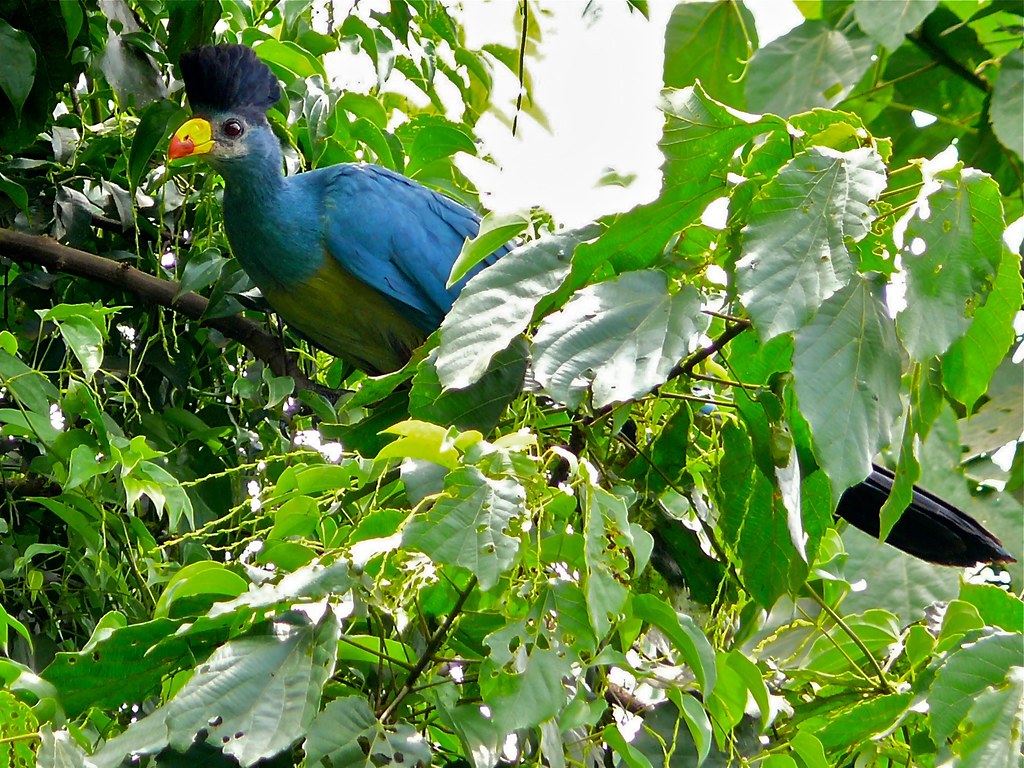
Great Blue Turaco — Uganda's Most Spectacular Bird
Pairs build a simple, loosely constructed stick platform nest high in a forest tree, usually 4-20 metres up. Both parents incubate the 1-3 eggs and feed the chicks regurgitated fruit. Young turacos are capable of clambering around branches near the nest well before they can fly properly, using their strong feet and a clawed digit on the wing (a trait shared with the related hoatzin lineage) to climb back up if they fall. Family groups often stay together for some months after fledging, which is why turacos are so often seen in small, noisy parties rather than singly.
Taxonomy and Similar Species
The great blue turaco is the largest of Africa's roughly 23 turaco species and sits in its own genus, Corythaeola. Uganda is also home to Ross's turaco and the Rwenzori (Ruwenzori) turaco, both smaller and mostly deep violet-blue rather than turquoise. None of Uganda's other turacos approach the great blue turaco's size or its combination of turquoise body, yellow breast band and orange-tipped bill, so field identification is straightforward once you've seen one.
Best Time of Year to See It
Great blue turacos are resident and present year-round at all the sites listed above, so there is no season when they disappear. Fruiting cycles do shift their exact location within a forest week to week, which is one reason a local guide who has scouted that morning's fruiting trees makes a real difference to how close and how quickly you get views, especially at busier sites like Entebbe Botanical Gardens.
Conservation Status
The great blue turaco is listed as Least Concern by the IUCN, with a wide range across Central and East Africa's forest belt and no major population decline recorded. Uganda's forest reserves and national parks — particularly Kibale, Bwindi and Semuliki — hold healthy populations, making the species one of the more dependable "guaranteed" sightings on a Uganda birding itinerary.
Where It Fits in a Uganda Itinerary
Because great blue turaco is so reliable at Entebbe Botanical Gardens, it's usually one of the first — and easiest — species ticked off on any Uganda birding trip, often within an hour of leaving the airport. That makes it a good confidence-builder early in a tour before tackling harder forest birds later at Kibale or Bwindi. Turacos at Kibale and Bwindi tend to be more wary and higher in the canopy than the habituated birds at Entebbe, so photographers in particular are often better served getting their close, low-angle shots at the gardens and treating sightings at the bigger forest parks as a bonus rather than the main opportunity.
A Note on the Name
"Turaco" (also spelled touraco) comes from a West African name for the group, and the family Musophagidae translates roughly to "banana-eaters" — a slight misnomer, since wild turacos take a much broader range of fruit than the name suggests. The great blue turaco's genus name, Corythaeola, references its prominent crest. Local Luganda names for the bird vary by region, and guides can usually point out the local name used around whichever site you're visiting, which is a small but memorable detail for travellers interested in more than just the checklist.