
Shoebill Stork Sound: The Bill-Clatter Call Explained
The shoebill stork sound is one of the most distinctive and disorienting sounds in African wildlife. Experienced birders who have heard every call in eastern Africa are stopped in their tracks the first time a shoebill begins its primary vocalisation at close range at Mabamba. It sounds nothing like a bird. It sounds like a machine — a rapid mechanical rattling, hollow and resonant, somewhere between a jackhammer operating at distance and the stuttering of an old diesel engine. It fills the papyrus swamp, carries 200 metres or more across still water, and is used by our community guides as the primary tool for locating shoebills before the birds are visible. Understanding the shoebill stork sound — what produces it, what it communicates, and how guides use it — transforms every Mabamba canoe session from passive observation into active tracking.
The Mechanism: How the Bill-Clatter Sound Is Produced
The shoebill's primary sound is not produced by the syrinx — the avian vocal organ used by most birds for song and calls. Instead, the shoebill bill-clatter is produced mechanically, by the rapid rhythmic striking of the upper mandible against the lower mandible. The mandibles are thick, solid keratin structures, and when they strike each other at the frequency the shoebill produces — approximately 10 to 15 strikes per second in a rapid burst — the hollow air space within the closed bill cavity acts as a resonating chamber, amplifying and deepening the mechanical impact sound into the distinctive rapid rattle that travels across the Mabamba channels.
The shoebill is not alone in using mandible-clattering as its primary communication method — storks also use this technique, and this behavioural similarity contributed historically to the confusion over the shoebill's taxonomic affinities. However, the shoebill's bill-clatter is faster, more sustained and more resonant than the clattering of any stork species, reflecting the larger bill cavity and different mandible proportions.
The clattering can be produced in varying rates. A slow, measured clatter — 5 to 8 strikes per second over 3 to 5 seconds — is the typical greeting sequence between a paired adult and its mate or between an adult and an approaching canoe it has assessed as non-threatening. A fast, continuous clatter of 12 to 18 strikes per second sustained for 10 to 30 seconds signals alarm, threat or high agitation.
The Low Booming Moan: The Shoebill's Vocal Call
In addition to the mechanical bill-clatter, the shoebill produces a genuine syrinx-based vocal call: a low, resonant, single-note moan or boom, described by some observers as similar to a distant foghorn and by others as resembling a cow's lowing heard through a tunnel. This call is lower in frequency than the bill-clatter and carries differently — while the bill-clatter is a sharp, directional rattling sound, the booming moan is a diffuse, omnidirectional low-frequency sound that seems to come from everywhere and nowhere simultaneously on first hearing.
The booming moan is used primarily at dawn, at dusk and during the breeding season as a contact call between mated pairs when they are separated by significant distance within their territory. At Mabamba, our guides hear this call on still October to January mornings before sunrise, as paired adults coordinate their positions across the swamp interior before the canoes arrive. It is a sound that carries real atmosphere: the darkness, the papyrus, the smell of the swamp and this low, unearthly sound from somewhere inside the vegetation.
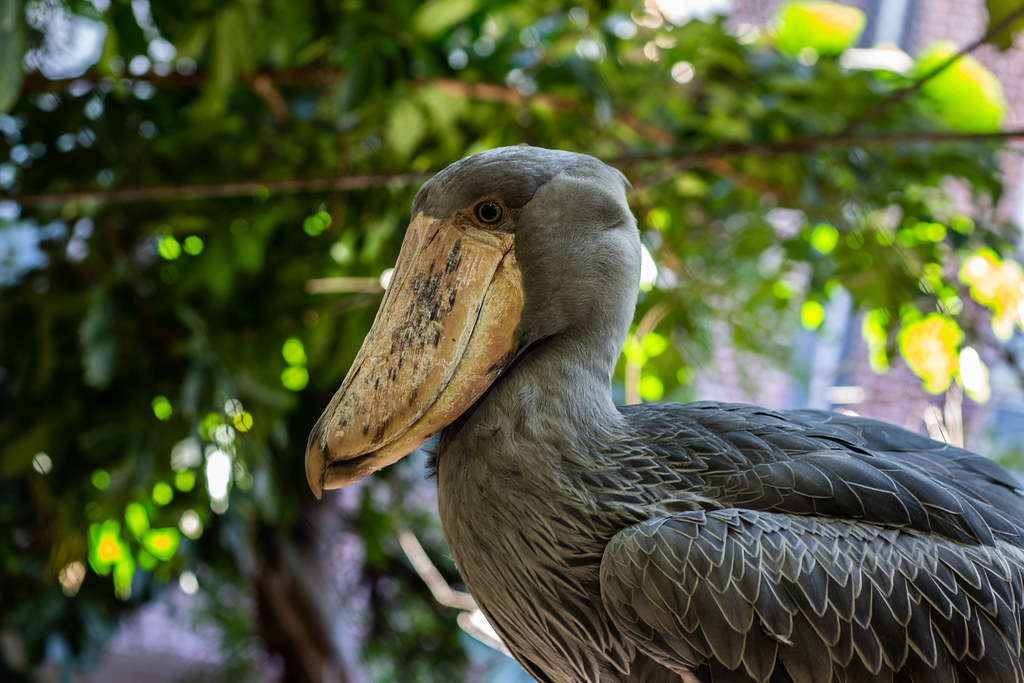
A shoebill stork in typical papyrus swamp habitat. Photo: Tom Woodward / Flickr (CC BY-SA 2.0)
What Each Shoebill Sound Means: A Field Guide to Shoebill Vocalisations
Slow greeting clatter (3 to 6 seconds, moderate speed): The most commonly heard bill-clatter at Mabamba. Produced when a habituated adult is approached from downwind by a correctly-handled canoe. This clatter is accompanied by a slight forward bow of the head and bill, followed by the head returning to upright. It is the shoebill equivalent of a nod of acknowledgement. Our guides interpret this as the bird having assessed the canoe as familiar and non-threatening and producing the standard social greeting it uses with its mate.
Fast alarm clatter (10 to 20 seconds, high speed): Produced when the bird is alarmed by an unexpected approach, by a territorial intrusion from another shoebill, or when the canoe moves too quickly toward the bird's personal space. This clattering is louder, faster and more continuous than the greeting clatter. The bird simultaneously raises its crest, narrows its posture (pulling wings tight to body) and may begin walking backward into the papyrus. When a Mabamba guide hears this call intensify, the canoe immediately stops and holds position until the bird settles — the same approach protocol covered in our canoe etiquette guide.
Territorial challenge clatter: The clattering produced by one adult directed at an intruding shoebill is the longest and most intense form of the call — 30 seconds to several minutes of continuous fast clattering, produced while advancing toward the intruder with bill held horizontal and wings slightly spread. During the breeding season at Mabamba, this territorial clattering is sometimes audible for 400 metres across the swamp as the resident adult drives a sub-adult out of its foraging zone.
Low moaning contact call: The syrinx-based vocal call described above. Produced mainly before dawn and during the breeding season. Not accompanied by any visible posture change. Functions as a long-range location broadcast between paired adults.
How Mabamba Guides Use Sound to Find Shoebills Before Seeing Them
The bill-clatter carries 150 to 250 metres in still early morning air across the open papyrus channels at Mabamba. An experienced guide on a silent canoe can hear a clattering shoebill from multiple channel-widths away — before the bird is visible and often before the canoe has even entered the channel section where the bird is feeding.
When our guide hears clattering from the papyrus, the canoe stops immediately. The guide orientates to the sound source — often turning the canoe through 90 degrees or reversing through a channel junction to approach from a better angle. The direction and intensity of the clatter tells the guide whether the bird is in the open margin (louder, clear direction) or deep in the papyrus interior (muffled, direction harder to resolve). A slow greeting clatter heard as the canoe approaches means the bird has already registered the canoe's presence and deemed it non-threatening — the guide can approach more directly.
On mornings when the wind picks up after sunrise and carries sound unpredictably, locating shoebills by sound is harder and the guide works more by systematic channel coverage. Calm mornings — typically the first hour after dawn — are when sound detection works best and most quickly.
Frequently Asked Questions: Shoebill Stork Sound
What does the shoebill stork sound like?
The primary sound is a rapid mechanical rattling produced by the mandibles striking each other — not vocal, not musical, but hollow and machine-like. The secondary call is a low, resonant moan similar to a distant foghorn. Together they are unmistakable once heard and cannot be confused with any other African bird.
Why does the shoebill clatter its bill?
Bill-clattering serves three functions: social greeting between mates or toward a familiar presence (slow clatter), alarm or threat response (fast clatter), and territorial defence against rival shoebills (sustained aggressive clattering). The same mechanism produces different messages through speed and duration.
Can I hear the shoebill call before seeing it at Mabamba?
Yes — this is how our guides find the birds on many mornings. The bill-clatter carries 150 to 250 metres across still water. On a calm morning the guide often hears the shoebill clattering from an adjacent channel before the canoe has rounded the papyrus bend to see it.
Does the shoebill make any other sounds?
Juveniles produce high-pitched begging calls when requesting food from parents — a sound similar to a hiccupping squeak. Adults at nest sites occasionally produce low grunting sounds during incubation changeover. The bill-clatter and low moan are by far the most frequently heard vocalizations.
Learn more about the shoebill's biology and behaviour, or book a Mabamba canoe trip with Shoebill Uganda Bird Tours — our guides use sound to locate the shoebill before most visitors even know where to look.