
Nabajjuzi Swamp Shoebill: Uganda's Quiet Alternative to Mabamba
Nabajjuzi Swamp is Uganda's least-known shoebill site and the one closest to Kampala after Mabamba. Located approximately 100 kilometres southwest of Kampala near Masaka town — about 90 minutes on the good Kampala–Masaka–Mbarara highway — Nabajjuzi is a significant papyrus wetland system in the upper Kagera River drainage that holds a small but established shoebill population. Its practical obscurity is not because the site is poor: it is because Mabamba is so reliably excellent that few visitors have reason to divert to a secondary site. For birders extending beyond the standard Uganda circuit, or wanting to see the shoebill in a genuinely unstructured, uncommercialised context, Nabajjuzi Swamp is worthwhile.
The Nabajjuzi Wetland System
Nabajjuzi Swamp forms part of the upper Kagera River headwater catchment in the southern Lake Victoria basin. The main swamp occupies a broad shallow valley between the Masaka highway and the eastern shore of Lake Nabajjuzi — a small shallow lake connected to the swamp complex by channels that flood seasonally. The papyrus stands here are extensive, covering several square kilometres, and the water depth in the main swamp channels ranges from 30 centimetres to over 1 metre — appropriate lungfish habitat that supports resident shoebills year-round.
The swamp is used daily by local fishing families who net tilapia and lungfish from wooden dugouts along channels that have been known to these communities for generations. Cattle farmers graze herds on the papyrus margins, particularly in the dry season when the receding water exposes broad mudflats where cattle drink and egrets feed. There is no national park boundary, no formal protection and no established ecotourism programme — Nabajjuzi is a working African wetland with wildlife and livelihoods coexisting without management.
Shoebill Sighting Reliability at Nabajjuzi
Shoebill records at Nabajjuzi span at least two decades in the ornithological literature and include consistent reports from Ugandan birders, academic ornithologists and eBird submitters. The resident population is estimated at 3 to 8 individuals based on the most recent surveys — small but sufficient to make a guided morning visit reliably productive. Our estimated sighting success on a well-guided Nabajjuzi visit is 60 to 70%.
The critical difference from Mabamba is the absence of habituated, territory-mapped birds with known current locations. At Nabajjuzi, the guide knows the general areas the birds use, the productive hunting channel sections and the water levels that concentrate shoebills at accessible margins — but there is no equivalent of the Mabamba community guide who checked the bird's location that morning or the previous evening. Finding a shoebill at Nabajjuzi involves genuine searching rather than guided approach to a known individual.
When a shoebill is found at Nabajjuzi, the encounter is typically from 40 to 80 metres — greater than Mabamba but comparable to Murchison Falls. The birds at Nabajjuzi have not had decades of habituating canoe exposure. They are more readily disturbed and more likely to step back into the papyrus interior when approached. For photographers, this makes Nabajjuzi a challenging secondary site. For birders who value the element of discovery, it is exactly right.
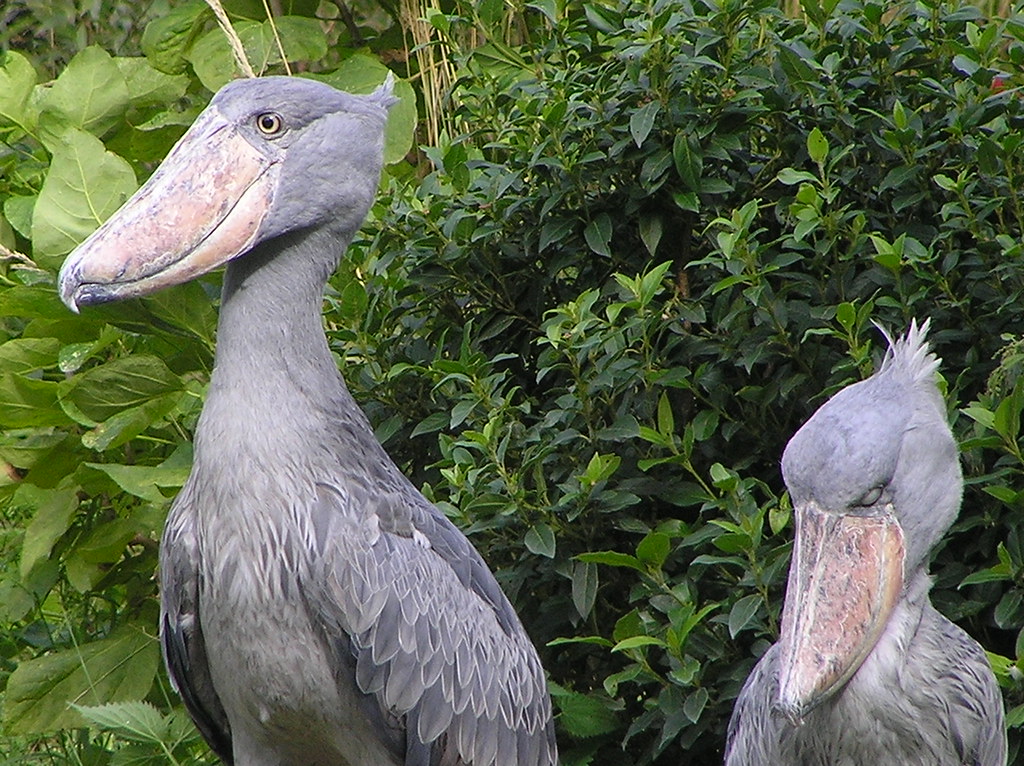
A wild shoebill stork, Balaeniceps rex. Photo: Frank Wouters / Flickr (CC BY 2.0)
How to Access Nabajjuzi Swamp
The main access point is from the Kampala–Masaka highway at the Lake Nabajjuzi turnoff, approximately 100 kilometres southwest of Kampala. From the highway, a dirt track leads 3 to 5 kilometres to the swamp edge and local fishing landing. A 4WD vehicle is advisable in wet season; the track is passable in a standard saloon car in dry conditions.
There is no formal accommodation at the swamp. Masaka town, 12 to 15 kilometres from the main access point, has a range of options from budget guesthouses to the comfortable Laburnum Hotel on the Masaka hill. Nabajjuzi is best visited as a half-day addition to an overnight in Masaka — either southbound toward Bwindi and the western parks or northbound returning to Kampala from the southwest circuit.
Canoe access requires prior arrangement with a local guide who knows the swamp. We can arrange this for our clients. There is no walk-up ecotourism infrastructure at Nabajjuzi — arriving without a guide and attempting to hire a fisherman's canoe independently is possible but considerably less efficient and potentially less safe than pre-arranged access.
Other Species at Nabajjuzi Worth Targeting
The Nabajjuzi wetland complex holds the full range of Lake Victoria papyrus specialists. Papyrus gonolek — the striking black-and-crimson near-endemic of Lake Victoria papyrus — is always audible and frequently visible at channel edges. Lesser swamp warbler is abundant and conspicuous. White-winged swamp warbler — less common than the lesser — occurs here and requires careful searching of dense papyrus stands. African jacana runs across the floating vegetation in open water patches. Malachite kingfisher perches at eye level on papyrus stems. Long-tailed cormorant dries its wings on exposed papyrus clumps.
At the swamp margins, yellow-bishop in breeding plumage displays from tall grass stems during October to February. Black-headed weaver nests in colonies in the papyrus fringe. Fan-tailed widowbird displays over the adjacent dry grassland. African fish eagle calls from the tall trees on the swamp perimeter. A thorough morning at Nabajjuzi, covering both the papyrus interior and the swamp edge transition, reliably covers 50 to 70 species.
Frequently Asked Questions: Nabajjuzi Swamp Shoebill
Is Nabajjuzi worth visiting when Mabamba exists?
Yes, for birders who have done Mabamba and want a more genuinely wild secondary shoebill encounter, or for visitors on the Kampala-to-Bwindi road who want a productive half-day stop that goes beyond just driving.
Can Nabajjuzi and Mabamba be done on the same day?
With an early start, yes. Mabamba canoe from 6am to 9am, drive to Nabajjuzi arriving 10:30am for a 3-hour session, back to Kampala or Masaka by 2pm. This is a full and productive Uganda birding day.
Does Nabajjuzi have a community guide programme?
No certified community programme equivalent to Mabamba exists at Nabajjuzi. We use local guides with personally verified swamp knowledge. Walk-in birding without a local guide is possible but significantly less effective.
Other Species at Nabajjuzi Swamp
While the shoebill is the headline target at Nabajjuzi, the swamp holds a productive bird community that makes the visit worthwhile for general Uganda birding beyond the headline species. Papyrus yellow warbler — one of the papyrus-specialist species restricted almost entirely to this specific habitat — is more reliably heard and seen at Nabajjuzi than at many larger wetlands because the swamp's compact size concentrates the population. White-winged warbler, another papyrus specialist, calls from the dense interior. Lesser swamp warbler is abundant. Swamp flycatcher perches on low reeds at the swamp margin. African rail calls from the papyrus base in the early morning — a species that is heard far more often than it is seen. Black-and-white casqued hornbill forages in the fringing trees adjacent to the papyrus. The open water areas of Nabajjuzi hold African jacana, long-tailed cormorant and pied kingfisher in numbers. Grey-crowned crane, Uganda's national bird, uses the adjacent grassland areas. For a birder travelling the Kampala–Masaka–Bwindi corridor, adding a 3-hour Nabajjuzi stop produces 40 to 60 species at minimal time cost — the swamp is accessed directly from the main road.
Read our how to see the shoebill stork guide for general planning, then contact our team to add a Nabajjuzi Swamp shoebill visit to your Uganda itinerary — we can arrange local guide access and integrate it into your Kampala–Masaka–Bwindi route.