
Shoebill Stork at Lake Albert: Uganda's Undiscovered Rift Valley Site
The shoebill stork at Lake Albert is Uganda's most undervisited major shoebill site. Lake Albert — the long, narrow Rift Valley lake forming the border between Uganda and the Democratic Republic of Congo — holds a shoebill population distributed along its papyrus-fringed Ugandan shore, concentrated particularly in the Butiaba wetlands on the northeastern shore and in the marshes around the Victoria Nile delta where the river flows into the lake from the south. These birds are less studied, less habituated to visitors and considerably harder to reach than the Mabamba population, but they represent a significant portion of Uganda's total shoebill numbers and offer an encounter with the species in a completely different, wilder ecological context.
Where Shoebills Occur at Lake Albert
The shoebill population at Lake Albert is centred on the wetlands between Butiaba fishing port — approximately 60 kilometres northwest of Masindi — and the Victoria Nile delta to the south. This area contains extensive papyrus swamp along the lake shore, fed by seasonal Nile flooding and rainfall runoff from the Rift Valley escarpment above. The swamp structure is broadly similar to Mabamba but significantly larger in extent, far less navigated by visitors and with negligible ecotourism infrastructure.
The Butiaba wetland shoebill population is estimated at between 30 and 80 individuals based on intermittent ground surveys, though the true figure may be higher given the extent of unsurveyed papyrus interior. Unlike Mabamba, where every bird in the accessible canoe zone is known individually by name and territory, the Lake Albert birds have no equivalent monitoring programme. Encounters here are genuine wild-bird finds — the guide knows the general areas the birds use, the productive water levels and the accessible channel sections, but there is no equivalent of the Mabamba guide who confirmed the target bird's location 24 hours earlier.
Access and Logistics for Lake Albert Shoebill
Reaching Butiaba from Kampala takes approximately 4.5 to 5 hours: north to Masindi (about 3 hours on the good Kampala-Gulu highway), then west through Masindi town and down the Rift Valley escarpment road to the lake shore. The descent road drops approximately 600 metres in 15 kilometres — steep, winding and requiring a capable vehicle, but fully sealed and not technically dangerous in a 4WD or high-clearance vehicle.
Accommodation at Butiaba is basic — fishing camp-standard guesthouses rather than the eco-lodges of Uganda's major parks. For visitors accustomed to the ease of Mabamba from Entebbe, the Lake Albert shoebill site requires genuine logistical commitment. It is best incorporated into a broader western Uganda itinerary that already includes Murchison Falls (approximately 60 kilometres north) rather than as a standalone shoebill destination from Kampala.
Canoe access at Lake Albert for shoebill requires arrangement with local fishermen at Butiaba landing. There is no established ecotourism programme equivalent to Mabamba. A guide with current shoebill territory knowledge is essential — self-guided exploration in unfamiliar papyrus is not productive and carries genuine navigation risks. Our team can arrange a local guide with up-to-date knowledge of active shoebill areas in the Butiaba wetlands for visiting clients.
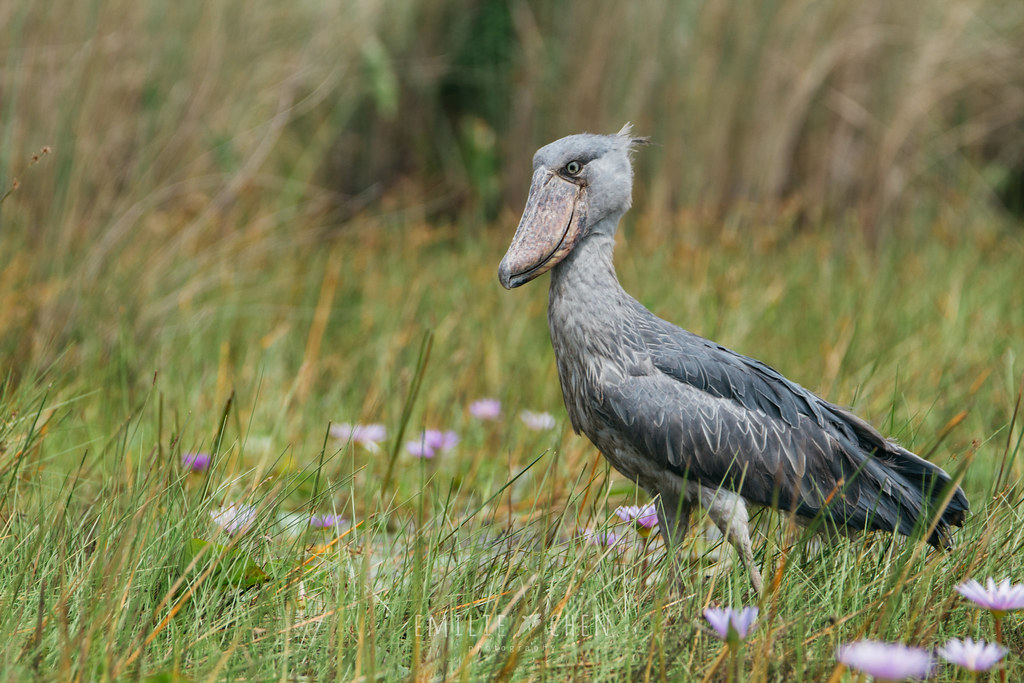
A shoebill stork, Balaeniceps rex. Photo: Emilie Chen / Flickr (CC BY-ND 2.0)
The Lake Albert Shoebill Encounter: What It Is Like
Because the Lake Albert shoebill population has not had years of regular gentle canoe approach by trained guides, individual birds are less habituated than the Mabamba adults. Approach distances are typically greater — 50 to 100 metres rather than Mabamba's 15 to 40 metres — and the birds more readily step back into the papyrus interior when the canoe approaches. This makes Lake Albert a more challenging shoebill photography site but a more genuinely wild encounter for birders who find the almost tame quality of Mabamba's habituated birds slightly at odds with the spirit of wild bird watching.
The landscape context at Lake Albert is dramatically different from Mabamba. The lake is a full Rift Valley lake, 160 kilometres long and up to 40 kilometres wide, with the DR Congo shoreline visible across the water. The Rift escarpment rises 600 to 800 metres above the lake on the Ugandan side, creating a visual backdrop of extraordinary scale. A shoebill at the Lake Albert papyrus margin, with the vast blue lake behind it and the escarpment wall above, has a presence and setting that no swamp near Entebbe can replicate.
Other Birds at Lake Albert Worth Targeting
The Lake Albert shoreline delivers a full range of rift valley and papyrus wetland species beyond the shoebill. Great white pelican and pink-backed pelican fish in the open lake in groups of 20 to 100 birds. African fish eagle calls from every riverside tree. Goliath heron stands in the papyrus margins. African skimmer rests on mid-lake sandbars during the dry season. The full papyrus wetland community includes papyrus gonolek, lesser swamp warbler, long-tailed cormorant, African jacana and African pygmy goose.
The lake shore itself and the Rift escarpment above add different species: the blue-headed coucal in the dense lakeside vegetation, Heuglin's francolin on the escarpment grasslands, beekeepers' and dry acacia woodland raptors including bateleur and martial eagle on the escarpment rim. A full day combining lake shore, papyrus canoe and escarpment drive can produce 100 to 130 species.
Frequently Asked Questions: Shoebill at Lake Albert
How reliable is shoebill sighting at Lake Albert?
Our estimated sighting rate is 55 to 65% on a well-guided Lake Albert canoe session — significantly lower than Mabamba but comparable to Murchison Falls. A second morning significantly improves overall probability.
Is Lake Albert worth visiting specifically for the shoebill?
For a birder who has done Mabamba and wants a wilder, less structured encounter in spectacular Rift Valley scenery, yes. For a visitor for whom the shoebill is the primary target and reliability matters, Mabamba remains the definitive choice. See our Nabajjuzi Swamp guide for another secondary option closer to Kampala.
Can I combine Lake Albert with Murchison Falls on one itinerary?
Yes — this is the natural combination. Murchison Falls is 60 kilometres north of Butiaba. Our Murchison plus Lake Albert itinerary adds one Butiaba day to an existing Murchison Falls visit.
Species to Expect Alongside the Shoebill at Lake Albert
Lake Albert supports a rich waterbird community alongside the shoebill. The flat, shallow floodplain margins at Butiaba hold African openbill stork in large numbers during the wet season, with flocks of 50 to 200 birds common on exposed mudflats. African fish eagle is abundant along the entire lake shore — the call is constant background sound from dawn onwards. Goliath heron stands in the shallow margins at the same sites as the shoebill, though the two species maintain territorial separation at the individual territory level. African pygmy goose occurs in the floating vegetation on the lake surface. Pink-backed pelican roosts in the shoreline acacias. The open lake itself draws lesser flamingo in some years — not a predictable sighting but recorded at Lake Albert during drought years when water chemistry at soda lakes forces flamingos to alternative feeding sites. The fishermen's landing sites at Butiaba attract pied kingfisher in extremely high numbers — the fish offal and small bycatch discarded at the landing draws kingfishers from across the lake margin. For a Uganda birding itinerary focused on waterbirds and Rift Valley species, Lake Albert adds a species community distinct from both Queen Elizabeth and Mabamba, with the shoebill as the headline target but a supporting cast of 60 to 80 additional waterbird species.
Read our how to see the shoebill stork guide, then contact our team to arrange a Lake Albert shoebill visit with local guide, including transport, canoe access and accommodation at Butiaba.